A physical kart on a virtual course
We built an augmented reality go-kart around a real, drivable kart. The game, TDX Cart, is a mixed reality kart race inspired by Mario Kart. The rider walks or drives a loop once to record the course, and a Meta Quest 3 lays a glowing rainbow road over the real ground with coins and items along the road. Picking up an item changes how the real kart drives. A coin, for example, raises the kart’s top speed by 4%. The game event has a physical effect rather than only changing a display.
Building the kart
Beyond the software, we sourced the parts, designed the electrical components, and welded the frame together. The frame, motor hardware, and electronics all had to work as one physical build, so fabrication and wiring were part of the same project as the AR game.
Connecting the game to the throttle
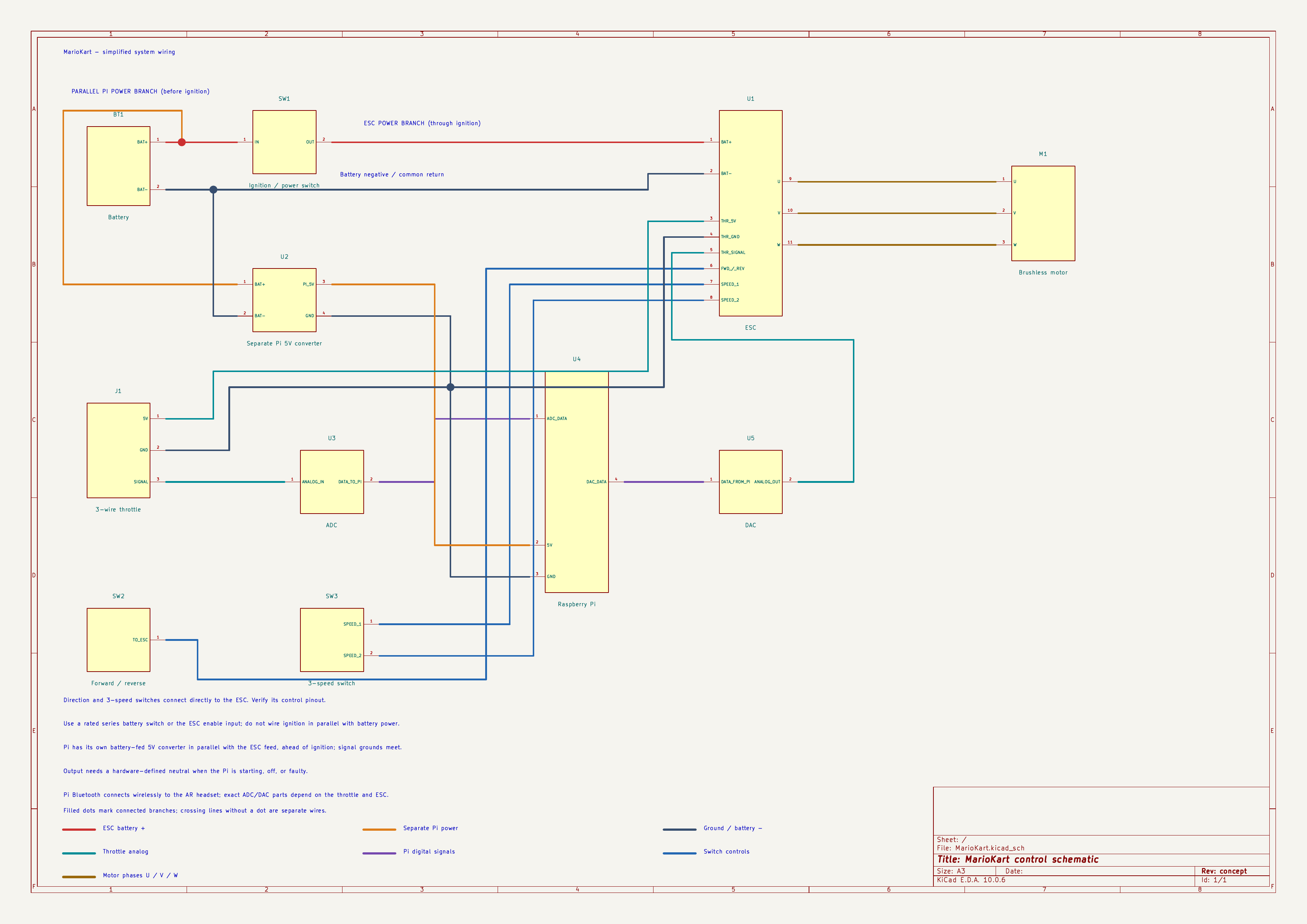
We intercepted the throttle signal between the foot pedal and the motor controller. A Raspberry Pi sits in that path. An ADC reads the pedal, the Pi combines the pedal position with a speed multiplier from the headset, and a DAC writes the result to the motor controller. The headset adds up the active boosts and streams the multiplier to the Pi 20 times a second over UDP, through a Wi-Fi hotspot hosted on the Pi. On the bench, full pedal gave about 2.47 V at a multiplier of 1.00 and ramped smoothly to about 2.95 V at 1.30.
Safety is handled at both ends. The app always runs in passthrough mode, hides virtual content whenever tracking is uncertain, and sends a multiplier of zero while tracking is lost, so the kart gets no motor power. If the headset stops sending, the Pi returns the throttle to neutral, and the kart also has a physical kill switch.
As of October 2026, the full chain from foot pedal through the Pi to the motor controller runs with boosts on the bench. A hardware watchdog and the first full ride are next.
The schematic describes the control architecture, not a measured speed change or a claim about the system’s operating limits.
Electrical schematic
The KiCad drawing shows the battery and ESC power paths, the separate Raspberry Pi supply, and the throttle signal routed through an ADC, the Pi, and a DAC before reaching the motor controller. The drawing also shows the direction and speed switch connections. This is a concept revision; the notes on the drawing identify checks still needed for the exact controller pinout and a defined neutral output during startup or a fault.